
Imagine a vulnerable patient brought into the Emergency Department in critical condition. The doctor must make a split-second decision regarding a major intervention. But does this doctor know what the patient would have wanted? Is there a Do Not Resuscitate (DNR) order, or perhaps a strong desire for life-prolonging treatment? For moments like these, Proactive Care Planning (PCP) was created: a vital compass for dignified care. In this article, we highlight what PCP entails, the IT challenges surrounding it, and the steps being taken to solve them. We conclude with a brief showcase of our own PCP solution.

What is Proactive Care Planning?
Proactive Care Planning (this is the literal translation for the Dutch PZP, it is also internationally known as Advance Care Planning or ACP) is the process where a patient, together with their healthcare provider and loved ones, discusses future care goals and treatment preferences in a timely manner. While often discussed within the context of palliative care, PCP is broader: it is about how someone wishes to live as their health declines. It is essentially a plan for 'just in case', where physical, psychological, social, and existential matters converge. By documenting this early and clearly, healthcare providers can ensure that care remains aligned with an individual's personal values, even if they are eventually no longer able to make decisions for themselves.
At its core, PCP involves:
- An ongoing conversation about what matters to the patient and which scenarios they would like to avoid.
- Documentation of treatment preferences (e.g., the desire to remain at home for as long as possible or specific wishes regarding pain management).
- Establishing treatment boundaries – what does the patient explicitly not want?
- Appointing a proxy or legal representative. This is the person authorised to make decisions if the patient can no longer do so.
In short, PCP provides clarity and direction for healthcare professionals and ensures the patient retains as much autonomy as possible over their treatment.
The Challenges Surrounding PCp
PCP plays a crucial role in the care process. However, recording and accessing PCP data effectively presents several challenges:
Availability across the care chain
Crucial patient wishes are often 'trapped' in local silos, even though a patient frequently interacts with multiple providers (GP, clinicians, home care, etc.). Information regarding treatment preferences is often unavailable to all providers in the chain when it is needed most.
Information is then frequently shared as documents, leading to a proliferation of different versions. This increases the risk of errors and requires significant manual labour.
A continuous process
PCP is not a one-off exercise – it is an ongoing process, where wishes and boundaries may change over time. It is vital that care providers, especially in acute situations, have access to the most current information and can see when and by whom it was recorded.
Speaking the same language
Different regions and organisations often develop their own processes and forms using local terminology. This makes the exchange of data between disparate IT systems exceptionally complex.
solutions
Work is underway from various angles to address these challenges. PCP/ACP is often cited as a use case for the broader issue of data availability, since it covers many relevant aspects. We highlight some key developments:
Standardisation of Information
International and national standards (such as FHIR profiles and openEHR) are being increasingly adopted/explored to ensure that data like treatment wishes and legal representatives can be exchanged in a uniform way.
 PCP solution CODE24 & Cadasto
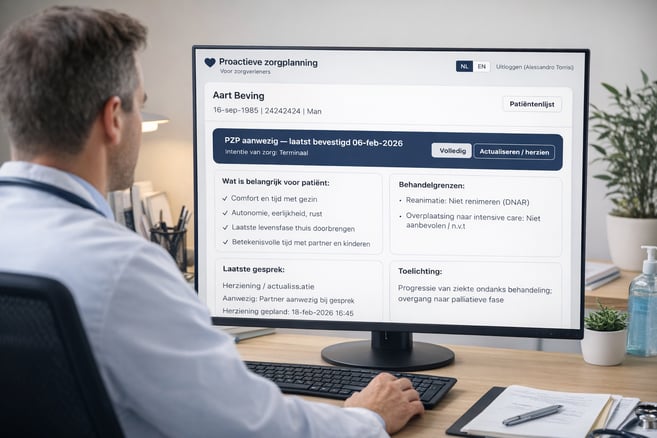
The PCP solution from CODE24 and Cadasto
At CODE24 and through our partner Cadasto, we have dived deep into this issue. Based on input from various stakeholders, we have developed a PCP solution that provides a clear, up-to-date overview of the PCP, accessible per patient. CODE24 developed the interface, while the data is stored by Cadasto, standardised according to the openEHR specification. By separating data from the application, we can develop such tools much faster and more efficiently.
While many regional initiatives focus on 'viewer' solutions, CODE24 approaches this from the perspective of a 'single source of truth', with the option to update information via write-access. Because the data is stored in Cadasto, full history and audit logging are always available.
CODE24 is currently very active within mental healthcare. We are in discussions with national mental care bodies to deploy this PCP solution for unlocking specific mental health-related PCP data from Electronic Health Records (EHRs) using the correct terminology. Furthermore, we are working on aligning with other standardisation initiatives (mostly on a Dutch national level). While many initiatives use FHIR, Cadasto works with openEHR; therefore, we are developing the necessary mappings to ensure seamless interoperability.
We look forward to presenting this solution to interested parties and engaging with organisations and regions regarding its further development. Would you like to discuss this topic with us? Or are you curious about how this solution could be integrated into your source system? We would love to hear from you.