
The healthcare sector is rapidly evolving. In this article, we outline the five healthcare IT trends we expect to see in 2026 and how they are likely to make a difference for healthcare organisations, healthcare professionals and their patients.

1. AI: working smarter for better care outcomes
In 2026 we expect to see a growing focus on how artificial intelligence (AI) and machine learning can move beyond the hype and deliver real value in everyday clinical practice. The emphasis is shifting from experimental pilots to applications with measurable outcomes, appropriate guardrails and supporting policies. We are seeing promising applications in areas such as automated summaries, voice-driven reporting (for example in our new mobile app), data analysis and pattern recognition, and virtual assistants. The key will be scaling these solutions thoughtfully, with a strong focus on safety and demonstrable value.
However, the success of AI depends on smart integration with existing healthcare processes and the availability of reliable data. This brings us to the next trend: data governance.
2. Data governance
Strong data governance forms the foundation for successful digital healthcare innovation. AI and data analytics are only valuable if the underlying data is of high quality. In 2026, we expect to see healthcare organisations taking further steps to professionalise their approach to data management, standardisation and cybersecurity.
Healthcare providers will need to optimise processes around data quality—not only to comply with regulations, but also to fully benefit from today’s technological capabilities. Data governance is therefore a key theme that reinforces both innovation and trust in digital healthcare.
At CODE24, we embrace open standards such as openEHR to store data securely, in a standardised and reusable way. This promotes interoperability and collaboration between systems and organisations, while also providing significant value for AI applications. openEHR structures data in a way that makes it easier for AI systems to retrieve and interpret information accurately.
3. Separation of data and applications
The separation of data and applications is increasingly seen as the way to prevent vendor lock-in and accelerate innovation. By decoupling data from the application layer—using openEHR data platforms such as Cadasto, for example—healthcare organisations retain control over their data and application landscape, enabling them to respond flexibly to new technological developments.
This approach is supported by, among others, the Dutch Ministry of Health, Welfare and Sport (VWS), as outlined in its 'National Vision and Strategy for the Health Information System'. It enables organisations to connect new applications easily, replace existing modules, or share data with partners without migration issues or dependency on a single supplier. This encourages an open, future-proof healthcare ecosystem in which data remains accessible and usable regardless of the software being used.
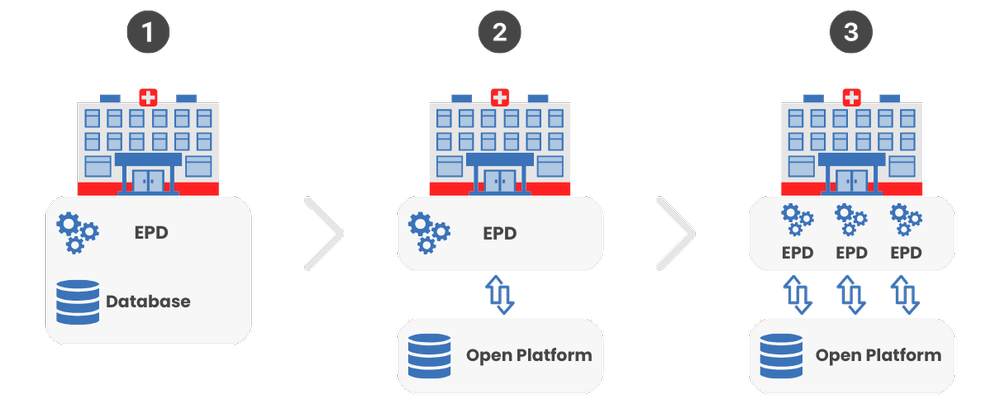 The transition from a traditional EHR architecture to a separation between data and applications.
At CODE24, we have applied this separation of data and applications since our earliest days, across our entire mConsole EHR and all our standalone solutions.
4. Continued digitalisation
As mentioned earlier, the successful use of AI applications and data analytics depends entirely on a solid foundation: high-quality data. In addition to clear agreements around data governance and data architecture, there are still many organisations and regions where the data simply does not yet exist in a usable form. Many processes still rely on separate documents, paper forms or even physical whiteboards. In order to gain meaningful insight from this information and manage operations effectively, these processes will first need to be digitised.
At CODE24, we see this in many organisations when it comes to requesting laboratory tests or managing admission processes in mental healthcare. Many organisations are interested in developments around data-driven healthcare and AI, but to truly benefit from these innovations, data must first be accessible and structured. The earlier organisations begin this process, the better.(For further perspective on this topic, be sure to read our interview with healthcare logistics expert Willem Teunissen from Zorgondernemers.)
5. Training and upskilling healthcare professionals
Digital transformation in healthcare requires more than just technology: its success ultimately depends on the people who use it. In 2026, many healthcare organisations are expected to invest in training and upskilling their healthcare professionals so that they can confidently and effectively use new digital tools. Good support and practice-oriented training also help to reduce resistance to change and encourage the adoption of innovative healthcare technologies.
CODE24 has seen that effective change management and continuous professional development are essential for the successful implementation of new healthcare technologies. In one of our earlier articles, we explored best practices for the successful implementation of new tooling in greater depth. By investing in people, healthcare organisations strengthen their adaptability and long-term resilience.
A promising year
Together, these five trends show that 2026 has the potential to become a turning point towards truly data-driven healthcare. Organisations that invest now in smart AI applications, robust data governance, a clear separation between data and applications, further digitalisation of their processes and targeted training for healthcare professionals will create a sustainable foundation for better care.
At CODE24, we believe that this combination of data, technology and people enables healthcare organisations to remain agile in responding to future developments. Not only in 2026, but well beyond, this approach can make a real difference for both patients and healthcare professionals.